


Heliconius clysonymus
Margarita Beltrán and Andrew V. Z. Brower
Introduction
A member of the erato species group that generally occurs at higher altitudes than H. erato.Characteristics
Early stages: Eggs are yellow and approximately 1.5 x 1 mm (h x w). Females usually place eggs singly on growing shoots of the host plant. Mature larvae have a white body with black and orange spots, and black scoli and yellow head; length is around 1.2 cm. Caterpillars are solitary (Brown, 1981). Pupae are brown with gold spots on the dorsum, the thorax is strongly bowed and has short abdominal spines. The head has long head horns, and the antennae have many short black spines (Brown, 1981; DeVries, 1997).
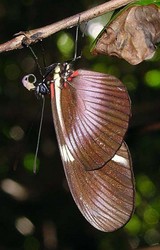
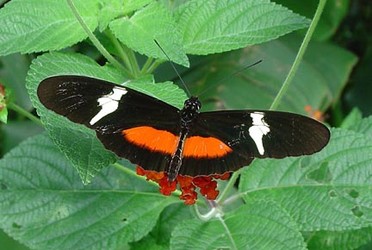
Adult: In Costa Rica H. clysonymus montanus is distinguished from all other species by the broad red medial band on the hindwing. Forewing length: 37-42 mm (DeVries, 1997).
Geographical Distribution
Heliconius clysonymus is distributed from Costa Rica to North Andes. This map shows an approximate representation of the geographic distribution of this species. The original data used to draw these maps are derived from Brown (1979) which is available at Keith S. Brown Jr. (1979). Ecological Geography and Evolution in Neotropical Forests
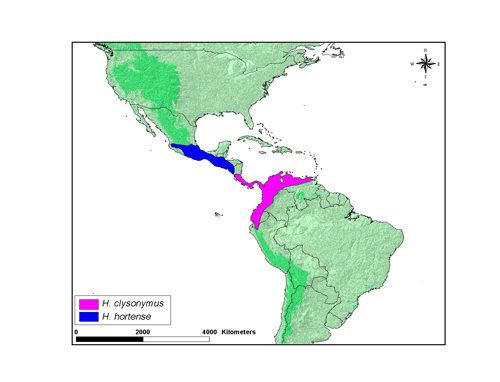
Distribution of Heliconius clysonymus and Heliconius hortense. © 2002 Margarita Beltran.
Habits
H. clysonymus occurs from sea level to 2,500 m in cloud forest. Usually individuals fly rapidly and in the lowerstory. The males sit on female pupae a day before emergence, and mating occurs the next morning, before the female has completely eclosed. Adults roost at night in small groups 2-10 m above ground in twigs or tendrils (Brown, 1981).
Host plant: H. clysonymus larvae feed primarily on plants from the genus Passiflora, subgenera Tryphostemmatoides and Plectostemma (Brown, 1981). In Costa Rica H. c. montanus feeds on Passiflora apetala and P. biflora (DeVries, 1997).
Other Names for Heliconius clysonymus
- Heliconius clysonimus fischeri
- Heliconius clynonimus flavopunctatus
- Heliconius micrus
- Heliconius clysonymus apicalis
- Heliconius clysonymus apicalis ab. semirubra
- Heliconius clysonymus perbellus
- Heliconius hygianus fischeri f. leoncitonis
- Heliconia hygiana
- Heliconius hygiana ab. albescens
- Heliconius montanus
- Heliconius clysonymus tabaconas
References
Brown K. S. 1981 The Biology of Heliconius and Related Genera. Annual Review of Entomology 26, 427-456.
DeVries P. J. 1997 The Butterflies of Costa Rica and Their Natural History, Volume I: Papilionidae, Pieridae, Nymphalidae Princeton University Press, Baskerville, USA.
Lamas, G., Ed. (2004) Atlas of Neotropical Lepidoptera. Checklist: Part 4A Hesperioidea - Papiionoidea. Gainesville, Scientific Publishers/Association of Tropical Lepidoptera.
Latreille P. A. 1817. Insectes de l'Amérique équinoxiale, recueillis pendant le voyage de MM. de Humboldt et Bonpland. Seconde partie. In: Humboldt, A. & A. Bonpland, 1805-1832, Voyage aux régions équinoxiales... Paris, G. Levrault, F. Schoell et Cie. 2(10): 97-138, pls. 35-43.
Title Illustrations
| Location | Chiriqui, Panama |
|---|---|
| Specimen Condition | Live Specimen |
| Source | Clysonymus Longwing |
| Source Collection | Neotropical Butterflies |
| Copyright | © 2004 Dan Wade |
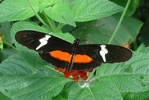
| Location | Chiriqui, Panama |
|---|---|
| Specimen Condition | Live Specimen |
| Source | Clysonymus Longwing |
| Source Collection | Neotropical Butterflies |
| Copyright | © 2006 Kim Garwood |
About This Page
Margarita Beltrán

University of Cambridge, Cambridge, UK
Andrew V. Z. Brower
Middle Tennessee State University, Murfreesboro, Tennessee, USA
Correspondence regarding this page should be directed to Margarita Beltrán at
beltran.margarita@gmail.com
and Andrew V. Z. Brower at
abrower@mtsu.edu
Page copyright © 2011 Margarita Beltrán and Andrew V. Z. Brower
 Page: Tree of Life
Heliconius clysonymus .
Authored by
Margarita Beltrán and Andrew V. Z. Brower.
The TEXT of this page is licensed under the
Creative Commons Attribution-NonCommercial-ShareAlike License - Version 3.0. Note that images and other media
featured on this page are each governed by their own license, and they may or may not be available
for reuse. Click on an image or a media link to access the media data window, which provides the
relevant licensing information. For the general terms and conditions of ToL material reuse and
redistribution, please see the Tree of Life Copyright
Policies.
Page: Tree of Life
Heliconius clysonymus .
Authored by
Margarita Beltrán and Andrew V. Z. Brower.
The TEXT of this page is licensed under the
Creative Commons Attribution-NonCommercial-ShareAlike License - Version 3.0. Note that images and other media
featured on this page are each governed by their own license, and they may or may not be available
for reuse. Click on an image or a media link to access the media data window, which provides the
relevant licensing information. For the general terms and conditions of ToL material reuse and
redistribution, please see the Tree of Life Copyright
Policies.
- First online 18 February 2007
- Content changed 26 May 2011
Citing this page:
Beltrán, Margarita and Andrew V. Z. Brower. 2011. Heliconius clysonymus . Version 26 May 2011 (under construction). http://tolweb.org/Heliconius_clysonymus/72928/2011.05.26 in The Tree of Life Web Project, http://tolweb.org/


