


Heliconius charithonia
the Zebra Longwing
Margarita Beltrán and Andrew V. Z. Brower
Introduction
A widespread neotropical species, ranging from the southern U. S. to subtropical southern South America and throughout the Antilles.
Etymology: The Charites, or Graces, are the personifications of charm and beauty in nature and in human life. They love all things beautiful and bestow talent upon mortals. Together with the Muses they serve as sources of inspiration in poetry and the arts. Originally, they were goddesses of fertility and nature, closely associated with the underworld and the Eleusinian mysteries (Charites).
Characteristics
Early stages: Eggs are yellow or white and approximately 1.2 x 0.8 mm (h x w). Females usually place 1 to 5 eggs on growing shoots of the host plant. Mature larvae have a white body, with black spots or bands, black scoli and yellow and black or black and white head; length is around 1.2 cm. Caterpillars are gregarious in small numbers (Brown, 1981).
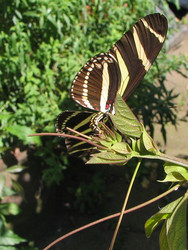
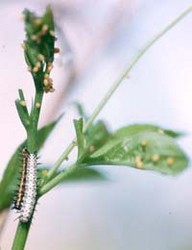
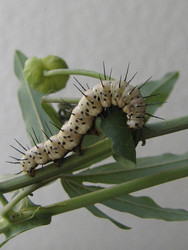
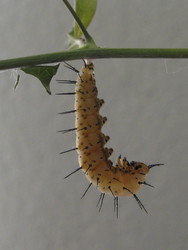
From left to right: Heliconius charithonia female laying eggs on her hostplant in Mexico City. © Maria Franco. Eggs, second, and third instar larva on hostplant in Gainesville, Florida. In Florida, H. charithonia larvae often completely defoliate their Passiflora hostplants. © Andrew V. Z. Brower . Last instar larva feeding on host plant and getting ready to pupate in Mexico City. © Maria Franco.
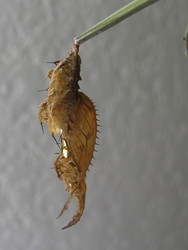
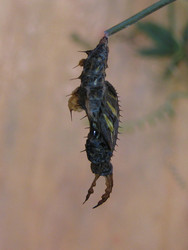
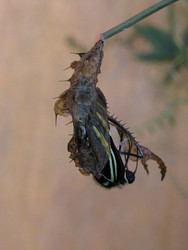
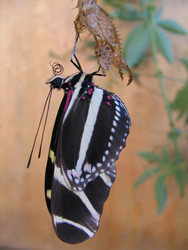
From left to right: Heliconius charithonia early pupa, pupa with butterfly ready to eclose, eclosing butterfly, and eclosed butterfly expanding and drying its wings. Mexico City, Mexico, November 2005 © Maria Franco.
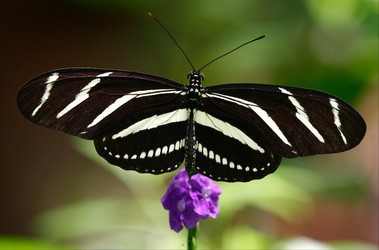
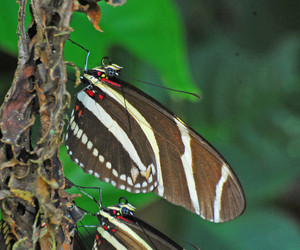
Adult: Distinguished immediately by the zebra pattern, which gives it the common name of the "zebra" (DeVries, 1997).
Geographical distribution and named races
Heliconius charithonia is distributed from North America (Texas and Florida) to Venezuela and Peru, and also occurs on the Greater and Lesser Antilles.
Although the species does not exhibit the dramatic geographical variation in wing patterns of some of its congeners, a number of names have been applied to various island populations.
H. charithonia charithonia (L., 1767)"America"(St. Thomas, Virgin Is., according to Comstock and Brown, 1950).
H. charithonia antiquus Lamas, 1988 (replacement name for H. charithonia punctata A. Hall, 1936 (preoccupied by h. cydno f. punctata Neustetter, 1907) (Antigua and St. Kitts)
H. charithonia bassleri Comstock & Brown, 1950 (Colombia)
H. charithonia churchi Comstock & Brown, 1950 (Haiti)
H. charithonia ramsdeni Comstock & Brown, 1950 (Cuba)
H. charithonia simulator Comstock & Brown, 1950 (Jamaica)
H. charithonia tuckeri Comstock Brown, 1950 (USA: Florida)
H. charithonia vasquezae Comstock & Brown, 1950 (Mexico: Campeche)
Habits
H. charithonia occurs from sea level to 1,800 m in edges and scrubs. Usually individuals fly erraticly and in the lowerstory. The males sit on female pupae a day before emergence, and mating occurs the next morning, before the female has completely eclosed. Adults roost at night in large groups lower than 2 m above ground in twigs or tendrils (Brown, 1981).
Host plant: H. charithonia larvae feed primarily on plants from the genus Passiflora, subgenus Granadilla, Tryphostemmatoides, and Plectostemma (Brown, 1981). In Costa Rica H. charithonia feeds on Tetrastylis lobata (Passifloraceae) (DeVries, 1997).
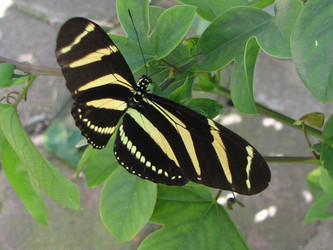
Heliconius charithonia on passion-vine in Mexico City, Mexico. © Maria Franco
Other Names for Heliconius charithonia
- Heliconius charitonia
- Heliconius charitonius
- Vernacular Names: the Zebra Longwing
References
Brower AVZ. 1994. The case of the missing H: Heliconius charithonia (L., 1767), not "Heliconius charitonia (L. 1767)". J. Lepid. Soc. 48: 166-168.
Brown K. S. 1981 The Biology of Heliconius and Related Genera. Annual Review of Entomology 26, 427-456.
"Charites." Encyclopedia Mythica from Encyclopedia Mythica Online. http://www.pantheon.org/articles/c/charites.html [Accessed May 22, 2008].
Comstock, WP, and Brown FM. 1950 Geographical variation and subspeciation in Heliconius charitonius Linnaeus (Lepidoptera, Nymphalidae). Amer. Mus. Novit. 1467, 1-21.
Davies N, and Bermingham E. 2002. The historical biogeography of two Caribbean butterflies (Lepidoptera: Heliconiidae) as inferred from genetic variation at multiple loci. Evolution 56: 573-589.
DeVries P. J. 1997 The Butterflies of Costa Rica and Their Natural History, Volume I: Papilionidae, Pieridae, Nymphalidae Princeton University Press, Baskerville, USA.
Lamas G ed. 2004. Atlas of Neotropical Lepidoptera. Checklist: Part 4A Hesperioidea - Papiionoidea. Gainesville: Scientific Publishers/Association of Tropical Lepidoptera.
Linnaeus, C. 1767. Systema naturae. Editio duodecima reformata. Holmiae, Laurentius Salvius. 1(2): [ii] , 533-1328 , [36] pp.
Title Illustrations
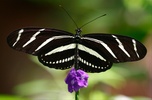
| Scientific Name | Heliconius charithonia |
|---|---|
| Specimen Condition | Live Specimen |
| Source | Zebra Longwing |
| Source Collection | Flickr |
| Image Use |
 This media file is licensed under the Creative Commons Attribution-NoDerivs License - Version 2.0. This media file is licensed under the Creative Commons Attribution-NoDerivs License - Version 2.0.
|
| Copyright | © 2006 Justin Lowery |
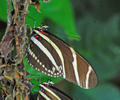
| Scientific Name | Heliconius charithonia |
|---|---|
| Location | above La Bajada, Nayarit, Mexico |
| Specimen Condition | Live Specimen |
| Source | WMex09_D-40-0270a |
| Source Collection | Flickr |
| Image Use |
This media file is licensed under the Creative Commons Attribution-NonCommercial-ShareAlike License - Version 2.0.
|
| Copyright | © 2009 Jerry Oldenettel |
About This Page
Margarita Beltrán

University of Cambridge, Cambridge, UK
Andrew V. Z. Brower
Middle Tennessee State University, Murfreesboro, Tennessee, USA
Correspondence regarding this page should be directed to Margarita Beltrán at
beltran.margarita@gmail.com
and Andrew V. Z. Brower at
abrower@mtsu.edu
Page copyright © 2010 Margarita Beltrán and Andrew V. Z. Brower
 Page: Tree of Life
Heliconius charithonia . the Zebra Longwing.
Authored by
Margarita Beltrán and Andrew V. Z. Brower.
The TEXT of this page is licensed under the
Creative Commons Attribution-NonCommercial-ShareAlike License - Version 3.0. Note that images and other media
featured on this page are each governed by their own license, and they may or may not be available
for reuse. Click on an image or a media link to access the media data window, which provides the
relevant licensing information. For the general terms and conditions of ToL material reuse and
redistribution, please see the Tree of Life Copyright
Policies.
Page: Tree of Life
Heliconius charithonia . the Zebra Longwing.
Authored by
Margarita Beltrán and Andrew V. Z. Brower.
The TEXT of this page is licensed under the
Creative Commons Attribution-NonCommercial-ShareAlike License - Version 3.0. Note that images and other media
featured on this page are each governed by their own license, and they may or may not be available
for reuse. Click on an image or a media link to access the media data window, which provides the
relevant licensing information. For the general terms and conditions of ToL material reuse and
redistribution, please see the Tree of Life Copyright
Policies.
- First online 18 February 2007
- Content changed 21 July 2010
Citing this page:
Beltrán, Margarita and Andrew V. Z. Brower. 2010. Heliconius charithonia . the Zebra Longwing. Version 21 July 2010 (under construction). http://tolweb.org/Heliconius_charithonia/72949/2010.07.21 in The Tree of Life Web Project, http://tolweb.org/


